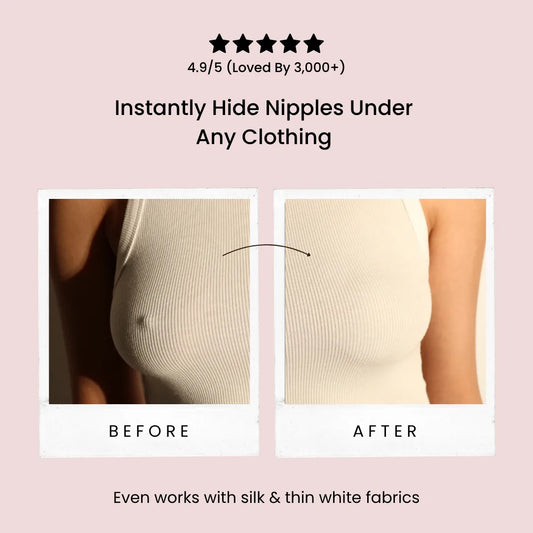


Adhesive vs non-adhesive nipple covers: how to choose
Share
The short answer
Adhesive nipple covers stick directly to your skin and stay in place on their own. Non-adhesive nipple covers rely on body heat and the pressure of your outfit to hold them in place, with no sticky layer involved.
The right choice depends on what you are wearing.
- If your outfit is loose, backless, strapless, or unsupported, adhesive is usually the better starting point.
- If your outfit is snug, fitted, or worn with an unlined bra, non-adhesive can work well and feels more comfortable for many people.
That is the simplest version. But the full answer depends on the neckline, the fabric, the weather, and what you actually need the cover to do. This guide walks through all of it so you can choose with more confidence and fewer wasted purchases.
What is the actual difference between adhesive and non-adhesive nipple covers?
The difference is not about quality. It is about how the cover stays in place.
How adhesive nipple covers work
Adhesive nipple covers are reusable silicone covers with a sticky layer on the inside. You apply them directly to clean, dry skin and they hold themselves in place without needing any help from the garment.
This makes them more versatile across different outfit types because they do not depend on the clothing pressing them against the body.
How non-adhesive nipple covers work
Non-adhesive nipple covers are also made from silicone, but they have no sticky layer. Instead, the silicone surface grips lightly using body heat and natural skin contact. The garment then does some of the work by keeping pressure on the cover.
This means non-adhesive covers are not just "adhesive covers without the glue." They work differently and they work best in a narrower set of outfits, specifically ones that are snug enough to help hold the cover against the body.
A common mistake
One of the most common mistakes people make is assuming non-adhesive is universally more comfortable and therefore universally better. It can be more comfortable, but if the outfit does not provide enough support, non-adhesive covers can shift, slip, or feel unreliable, and that defeats the purpose.
The better way to think about it: adhesive is more versatile, non-adhesive is more comfort-led, and the outfit decides which one makes more sense.
When to choose adhesive nipple covers
Adhesive nipple covers are usually the better fit when the outfit itself cannot help hold the cover in place.
Best outfits for adhesive covers
- Backless dresses and tops. There is no bra band to keep anything pressed against the body, so adhesive hold matters.
- Strapless outfits. Similar logic. Without straps or structure, the cover needs to hold itself in place.
- Loose or flowy tops. If the garment is not pressing against the chest, a non-adhesive cover has nothing helping it stay put.
- Fitted tops where edge finish matters. Adhesive covers tend to sit flatter at the edges because they are bonded to the skin, which can reduce outline visibility under thin fabrics.
- Everyday versatility. If you are not sure what you will be wearing and want something that works across more outfit types, adhesive is the safer general-purpose choice.
Best situations for adhesive covers
- You are dressing for an event or occasion where you cannot risk adjusting.
- You are moving around a lot during the day and want more hold certainty.
- You are new to nipple covers and want a straightforward first option that does not depend on learning which outfits provide enough support.
- You are wearing a fabric or cut where even a slight shift would be noticeable.
Who adhesive covers suit best
Adhesive covers tend to suit customers who:
- Want coverage and do not mind adhesive contact on skin
- Wear outfits where a non-adhesive option would not have enough support
- Prefer a simpler recommendation that works in more scenarios
- Are first-time buyers who want less guesswork
When to choose non-adhesive nipple covers
Non-adhesive covers are the comfort-led option. They work well in specific conditions, but those conditions matter.
Best outfits for non-adhesive covers
- Snug tops and t-shirts. The fabric presses the cover against the body, doing the holding work that adhesive would otherwise do.
- Fitted dresses. If the dress sits close to the chest, non-adhesive can work smoothly.
- Under unlined bras. If you are wearing a bra that does not have lining or padding, non-adhesive covers can sit inside the bra cup and stay in place easily.
- Layered outfits with a snug inner layer. As long as something is pressing the cover against the skin, non-adhesive can hold comfortably.
Best situations for non-adhesive covers
- You dislike adhesive on your skin and want a no-stick option.
- You are wearing something snug enough that the garment will help hold the cover.
- You want a simpler, gentler wear experience for daily use.
- You are restocking and already know from experience which outfits provide enough support.
Who non-adhesive covers suit best
Non-adhesive covers tend to suit customers who:
- Want coverage but prefer no adhesive contact
- Wear snug clothing regularly
- Value comfort and simplicity over maximum outfit flexibility
- Already understand that the garment plays a role in keeping the cover in place
Side-by-side comparison
| Adhesive nipple covers | Non-adhesive nipple covers | |
|---|---|---|
| How it stays on | Adhesive layer sticks directly to skin | Body heat + garment pressure |
| Best outfits | Backless, strapless, loose, or open tops and dresses | Snug tops, fitted dresses, under unlined bras |
| Not ideal for | Customers who want no adhesive on skin | Loose, unsupported, or very open outfits |
| Comfort feel | Secure, but involves adhesive contact | Softer feel, no sticky layer |
| Hold versatility | Works across more outfit types | More dependent on the outfit providing support |
| Best for first-time buyers? | Usually yes, because it works in more situations | Better for buyers who already know their outfit suits it |
| Provides lift? | No — coverage only | No — coverage only |
| Reusable? | Reusable with proper care | Reusable with proper care |
How to decide: a step-by-step method
If you are still unsure, work through these four questions.
Step 1: Check the outfit
Look at what you are wearing and ask: will this outfit press the cover against my body?
- Yes, it is snug or fitted → non-adhesive can work.
- No, it is loose, backless, or unsupported → go with adhesive.
This single question narrows down the choice for most people.
Step 2: Check the neckline
If the neckline is very deep, plunge, halter, or sweetheart, the shape of the cover might matter more than the hold type.
- Standard crew, scoop, or regular neckline → round adhesive or non-adhesive covers, depending on step 1.
- Deep V, plunge, or halter → consider triangle covers, which are shaped to sit below the neckline edge without peeking out.
Triangle covers come in both adhesive and non-adhesive formats, so you can still choose your preferred hold method.
Step 3: Check the fabric
Thinner, lighter, or more sheer fabrics are less forgiving. Under these fabrics, every edge and every outline matters more.
- Thin or sheer fabric → adhesive tends to sit flatter at the edges, making outlines less likely.
- Thicker or more forgiving fabric → either option can work well.
Step 4: Check the weather and activity
If it is a warm day, you are going to be active, or you will be wearing the covers for a long time, comfort matters more.
- Hot weather and you still want adhesive hold → consider breathable covers, which are a branch of the adhesive family designed with more airflow in mind.
- Cool weather and snug outfit → non-adhesive can be a comfortable daily choice.
Common mistakes when choosing between adhesive and non-adhesive
Mistake 1: Assuming non-adhesive is always the more comfortable choice
Non-adhesive covers are more comfortable in the right outfit. But in the wrong outfit, a non-adhesive cover that shifts or slips is more uncomfortable than an adhesive one that stays put. Comfort depends on the fit, not just the hold type.
Mistake 2: Choosing non-adhesive for a backless dress
This is one of the most common mismatches. Backless dresses provide almost no garment support, which means non-adhesive covers have very little helping them stay in place. Adhesive is almost always the better option here.
Mistake 3: Thinking adhesive means lift
Adhesive nipple covers provide coverage. They stick to the skin and create a smooth finish under clothing. But they do not create lift, push, or reshaping. If you need lift, that is a different product category — boob tape or bra inserts are designed for that.
Mistake 4: Treating all nipple covers as interchangeable
Not every nipple cover does the same job. Adhesive and non-adhesive differ in hold method. Round and triangle differ in shape. Breathable covers differ in airflow. The right choice depends on what the outfit asks for, not just which cover you see first.
Mistake 5: Buying the wrong size and blaming the hold type
Sometimes the cover shows through or feels wrong not because the hold type is wrong, but because the size does not match the coverage area needed. Before switching from adhesive to non-adhesive or back again, check whether the size is right.
What about other types of nipple covers?
The adhesive vs non-adhesive decision is the most common starting point, but it is not the only choice you will need to make.
Triangle covers
Triangle covers are shaped for outfits with deeper or more angular necklines. Where a round cover might peek above a plunge or halter neckline, a triangle cover is cut to sit below the garment edge more cleanly.
Triangle covers are available in adhesive and non-adhesive options, so the hold type decision still applies on top of the shape decision.
When to consider triangle covers: You are wearing a plunge dress, deep V top, halter, or sweetheart neckline and are worried about the top edge of a round cover showing.
Breathable covers
Breathable covers are part of the adhesive family but designed with more airflow in mind. They are useful when you want adhesive hold but the weather or wear length makes comfort a bigger priority.
When to consider breathable covers: Hot weather, longer wear days, or any time you still want adhesive security but would prefer a cooler feel.
Boob tape
Boob tape is a different product from nipple covers. Tape is designed for lift and support, not just coverage. If you need your outfit to hold a specific shape, or if you need more structure than a flat cover provides, tape might be the better route.
When to consider boob tape: You need lift for a strapless, backless, or low-cut outfit. Coverage alone will not solve the problem.
Bra inserts
Bra inserts sit inside compatible garments and add shape or volume. They are not direct-to-skin coverage products in every scenario, but they solve the "I want more shape" problem that nipple covers are not designed for.
When to consider bra inserts: The outfit supports an insert and you want more structure or fullness, not just coverage.
Choosing by outfit: a quick reference
| Outfit | Best starting point | Why |
|---|---|---|
| Backless dress | Adhesive covers | No garment support for non-adhesive |
| Strapless dress | Adhesive covers | The dress is not pressing the cover in place |
| Snug t-shirt or fitted top | Non-adhesive covers | The garment holds the cover against the body |
| Thin white top | Adhesive covers | Flatter edge finish reduces outline risk |
| Deep V or plunge dress | Triangle covers (adhesive or non-adhesive) | Shape prevents edge from peeking above the neckline |
| Unlined bra | Non-adhesive covers | The bra cup holds the cover in place |
| Loose flowy blouse | Adhesive covers | Not enough garment pressure for non-adhesive |
| Hot weather outfit (snug) | Breathable covers or non-adhesive | Airflow matters more in warm conditions |
| Hot weather outfit (loose) | Breathable covers | Still need adhesive hold, but with more airflow |
| Event dress needing lift | Boob tape or bra inserts | Coverage alone is not enough |
How to apply adhesive nipple covers
Getting a smooth finish starts before you even put the cover on.
- Start with clean, dry skin. Oils, moisturiser, sunscreen, or sweat on the skin can weaken the adhesive and cause the cover to lift. Apply covers before you put on any body products.
- Centre the cover over the nipple. Hold the cover by the edges and position it where you want it to sit before pressing down.
- Press gently from the centre outward. This helps push out air pockets and makes the edges sit flatter against the skin.
- Smooth the edges down. Run your finger around the outside edge to make sure nothing is lifting. Flat edges are what stop the cover from being visible under thin fabrics.
- Check in a mirror before dressing. A quick look before putting on your outfit gives you the chance to adjust placement.
Removal tips
- Peel gently from one edge rather than pulling the whole cover off at once.
- If the adhesive feels very stuck, a small amount of warm water or gentle oil at the edge can help loosen it.
- Follow the current care instructions for cleaning and storing the adhesive surface after use.
How to use non-adhesive nipple covers
Non-adhesive covers are simpler to apply, but placement and outfit choice matter more.
- Clean, dry skin still helps. Even though there is no adhesive, a clean surface lets the silicone grip more effectively.
- Position the cover and hold briefly. Place it where you want it and hold gently for a few seconds to let body heat start working.
- Put on a snug garment over the top. The garment is doing part of the holding job. Without it, the cover may not stay reliably.
- Adjust once the garment is on. You can gently shift the cover through the fabric if it has moved during dressing.
What to watch for
- If the cover keeps shifting, the outfit may not be snug enough. This is a fit issue, not a product issue.
- Non-adhesive covers work best when you have already matched the outfit type to the product. If the outfit is too loose, switch to adhesive rather than fighting the fit.
How to care for reusable nipple covers
Both adhesive and non-adhesive covers are reusable with proper care.
- Wash after each wear using mild soap and water. Avoid harsh cleansers that could break down the silicone or adhesive.
- Air dry completely before storing. Do not use a towel to rub them dry, as lint and fibres can reduce the grip or adhesive quality.
- Store on a clean, flat surface or in the original case. Keeping the contact surface clean and protected extends the life of the product.
- Avoid contact with lint, dust, or fabric fibres between uses, as these reduce the hold over time.
Frequently asked questions
Can I wear non-adhesive nipple covers with a backless dress?
It is usually not the best match. Backless dresses do not press the cover against the body, which means non-adhesive covers have very little holding support. Adhesive covers are almost always a better choice for backless outfits.
Do adhesive nipple covers hurt to remove?
They should not if you remove them gently. Peel from one edge slowly rather than pulling them off quickly. If you find the adhesive very strong, a small amount of warm water or gentle oil at the edge can help. If you have sensitive skin, consider a patch test before wearing them for a full day.
Which type lasts longer?
Both adhesive and non-adhesive covers are reusable with proper care. The lifespan depends on how often you wear them and how well you clean and store them. Adhesive covers may gradually lose stickiness over time, while non-adhesive covers rely on the silicone surface staying clean and free of lint.
Can I wear nipple covers while exercising?
It depends on the activity and the outfit. For light movement in a snug top, non-adhesive can work. For higher-intensity activity, adhesive may feel more secure. Be honest about the level of movement involved and match the hold type to what the outfit and activity actually require.
Are non-adhesive nipple covers better for sensitive skin?
They can be a good option for people who find adhesive contact uncomfortable, since there is no sticky layer involved. However, if your outfit is not supportive enough for non-adhesive, you may end up needing adhesive anyway. In that case, a patch test on a small area of skin before full wear is a sensible step.
What if my neckline is too deep for round covers?
If the top edge of a round cover sits too close to the neckline and risks showing, triangle covers are designed for exactly that problem. They are shaped to sit below plunge, halter, and deep V necklines more cleanly than round covers.
The bottom line
Adhesive and non-adhesive nipple covers are not better or worse than each other. They solve the same problem — coverage and a smoother finish under clothing — but they do it in different ways, and they suit different outfits.
Start with the outfit. That single detail tells you more about which cover to choose than any other factor.
- Loose, open, backless, or unsupported → adhesive.
- Snug, fitted, or under an unlined bra → non-adhesive can work well.
- Deep neckline → consider triangle covers.
- Hot weather with adhesive hold → consider breathable covers.
- Need lift, not just coverage → look at boob tape or bra inserts instead.
The best nipple cover is the one matched to what you are actually wearing.